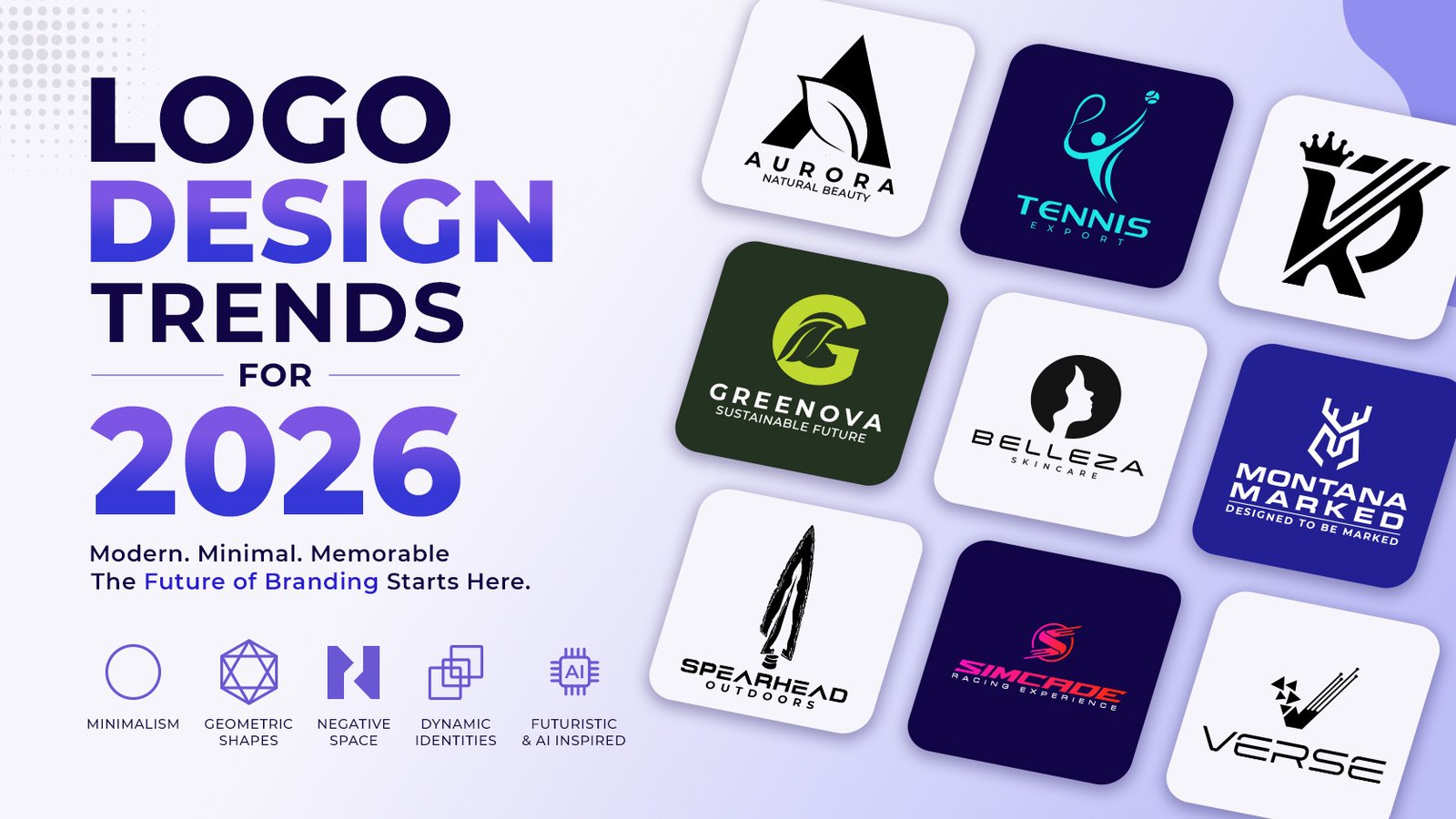
Logo design trends for 2026 are shaping how brands create powerful first impressions in an increasingly digital world. A logo is often the first visual element customers encounter before visiting a website, reading about a company, or purchasing a product, making it a critical part of brand recognition and trust.
Top Logo Design Trends for 2026
A logo is often the first impression a customer has of a brand. Before someone visits a website, reads a company description, or purchases a product, they usually encounter the logo first.
That’s why logo design continues to play a crucial role in modern branding.
As we move through 2026, businesses are looking for logos that are more adaptable, memorable, and versatile than ever before. Digital-first experiences, mobile interfaces, social media platforms, and AI-driven branding are influencing how logos are designed and used.
But while trends evolve, the goal remains the same: create a visual identity that instantly communicates trust, personality, and recognition.
Whether you’re a designer looking for inspiration or a business owner planning a rebrand, this guide explores the biggest logo design trends shaping 2026.
Why Logo Design Trends Matter
Following trends doesn’t mean copying them.
The best designers understand trends because they reveal how audiences respond to visual communication at a particular moment in time.
Logo trends help brands:
- Stay visually relevant
- Connect with modern audiences
- Improve digital usability
- Enhance brand recognition
- Differentiate themselves from competitors
The key is knowing which trends are temporary and which represent long-term shifts in branding.
Minimalist Logo Design Continues to Dominate
Minimalism isn’t new, but it remains one of the strongest logo trends in 2026.
Modern brands are simplifying their identities to improve readability across websites, mobile apps, social media profiles, and digital advertising.
Why Minimal Logos Work
Minimalist logos offer:
- Better scalability
- Faster recognition
- Cleaner visual communication
- Stronger adaptability
The goal isn’t to remove creativity—it’s to remove unnecessary complexity.
Real-World Example
Many global brands have simplified their logos over the past decade by removing gradients, shadows, and decorative details in favor of cleaner, more functional designs.
Practical Tip
When designing a logo, ask yourself:
“Can I remove one more element without weakening the concept?”
If the answer is yes, simplify further.
Geometric Logos Are Becoming More Popular
Geometric logo design is experiencing significant growth.
Brands are embracing:
- Circles
- Hexagons
- Triangles
- Grid-based systems
- Symmetrical forms
These shapes create a sense of structure, reliability, and professionalism.
Why Businesses Love Geometric Branding
Geometric logos often feel:
- Modern
- Intelligent
- Trustworthy
- Scalable
This trend is especially popular among technology companies, SaaS startups, consulting firms, and AI businesses.
Strategic Negative Space Logos
Negative space remains one of the most effective techniques in logo design.
Rather than adding more elements, designers create hidden meanings within existing shapes.
These logos often produce an “aha” moment that makes the brand more memorable.
Benefits of Negative Space
- Creates visual intrigue
- Improves memorability
- Encourages audience engagement
- Adds storytelling without complexity
Practical Tip
Don’t force negative space into a logo.
The strongest examples occur naturally as part of the concept rather than feeling artificially inserted.
Dynamic and Adaptive Logo Systems
One of the biggest shifts in branding is the move toward flexible identities.
Instead of using a single static logo, brands are creating adaptive logo systems.
These systems allow logos to:
- Change layouts
- Adjust sizes
- Animate digitally
- Adapt across platforms
Adaptive Logos: A Leading Force in Logo Design Trends for 2026
Brands now appear on:
- Websites
- Mobile apps
- Social media
- Smart devices
- Video platforms
A logo must perform consistently in every environment.
Dynamic identities help maintain recognition while increasing flexibility.
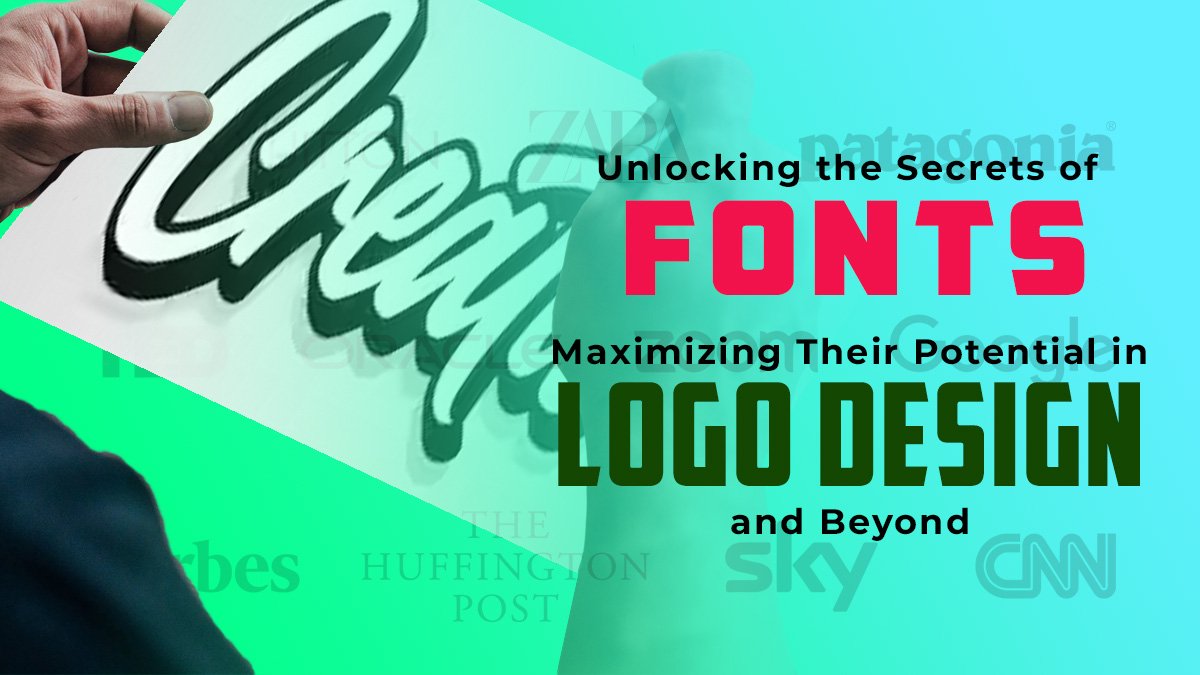
Custom Typography Is Replacing Generic Fonts
Typography is becoming the hero of modern logo design.
Many brands are investing in:
- Custom lettering
- Unique type systems
- Modified fonts
- Bespoke wordmarks
Why Custom Typography Stands Out
Consumers see thousands of logos daily.
Custom typography helps brands establish a distinctive visual voice.
A unique letterform can become as recognizable as an icon.
Real-World Example
Many premium brands rely almost entirely on custom typography instead of symbols to build recognition.
Bold Simplicity Is Replacing Delicate Details
Designers are moving toward stronger, bolder forms.
Thin lines and intricate details often disappear on mobile devices.
In response, many logos now feature:
- Heavier strokes
- Strong silhouettes
- Clear shapes
- Improved visibility
Why This Trend Is Growing
Most branding interactions happen on small screens.
A logo that looks perfect on a billboard but fails at 32 pixels is no longer effective.
AI-Inspired Logo Design Aesthetics
Logo design trends for 2026 are being heavily influenced by the rapid growth of artificial intelligence, shaping new visual styles, creative workflows, and brand identities.
This doesn’t mean logos are becoming robotic.
Instead, designers are exploring visual concepts that communicate:
- Intelligence
- Connectivity
- Data
- Automation
- Innovation
Common AI Design Elements
- Abstract networks
- Interconnected geometry
- Fluid digital forms
- Intelligent symbols
- Modular structures
Technology brands are particularly embracing this trend.
Modern Monograms Are Making a Comeback
Monogram logos continue to perform well in 2026.
A monogram combines initials into a unique and recognizable mark.
Why Monogram Logos Are Still Leading Logo Design Trends for 2026
They are:
- Compact
- Memorable
- Professional
- Versatile
This trend is especially strong in:
- Real estate
- Luxury brands
- Consulting firms
- Personal brands
- Financial services
Practical Tip
Avoid creating monograms that rely solely on overlapping letters.
Look for opportunities to build meaningful symbolism into the structure.
Organic Shapes and Human-Centered Branding
While geometric logos are growing, many brands are moving in the opposite direction.
Organic shapes are becoming popular because they feel:
- Human
- Friendly
- Authentic
- Approachable
These logos often feature:
- Curved lines
- Imperfect forms
- Natural movement
- Soft edges
Brands focused on wellness, sustainability, education, and lifestyle markets are particularly drawn to this trend.
Motion-Ready Logo Design
Logos are increasingly designed with animation in mind.
Even if a logo is static most of the time, designers now consider how it will move in digital environments.
Why Motion Matters
Animated logos can:
- Increase engagement
- Improve storytelling
- Enhance memorability
- Strengthen digital branding
A logo that transforms smoothly in video content often creates stronger audience connections.
Logo Design Trends for 2026: Blending Retro Character with Modern Style
One of the most interesting trends of 2026 combines classic design influences with modern execution.
Designers are blending:
- Retro typography
- Heritage-inspired layouts
- Simplified shapes
- Contemporary minimalism
The result feels both nostalgic and current.
This trend is especially popular among:
- Craft brands
- Food companies
- Coffee shops
- Lifestyle brands
Sustainability-Inspired Branding
Consumers increasingly support environmentally responsible companies.
As a result, logos are reflecting values such as:
- Sustainability
- Transparency
- Simplicity
- Natural living
Common visual characteristics include:
- Earth-inspired color palettes
- Organic forms
- Minimal production aesthetics
- Nature-based symbolism
Brands want their visual identity to communicate responsibility and authenticity.
Avoid These Mistakes When Following Logo Design Trends for 2026
While exploring trends, avoid these common mistakes:
Following Trends Blindly
A logo should fit the brand, not just the trend.
Overcomplicating Concepts
Complex logos often lose effectiveness across digital platforms.
Ignoring Scalability
Test logos at both large and small sizes.
Prioritizing Style Over Strategy
Beautiful logos fail when they don’t communicate the right message.
Designing Only for Today’s Platforms
Consider future adaptability and digital evolution.
How to Select the Best Logo Design Trends for 2026
The best logo trend depends on your brand goals.
Ask yourself:
- Who is the audience?
- What emotions should the logo create?
- Where will the logo appear most often?
- Does the trend support the brand story?
The strongest logos combine timeless principles with modern relevance.
Conclusion
Logo design in 2026 is focused on clarity, flexibility, and strategic communication.
The most successful trends aren’t necessarily the flashiest. They’re the ones that help brands communicate effectively across an increasingly digital world.
Whether it’s minimalist branding, custom typography, adaptive identities, geometric structures, or human-centered design, the common theme is intentional simplicity.
For designers, the challenge is not simply creating attractive logos.
It’s creating meaningful visual systems that remain memorable, functional, and relevant for years to come.
As branding continues to evolve, designers who understand both timeless fundamentals and emerging trends will be best positioned to create logos that truly stand out.
Frequently Asked Questions
What is the biggest logo design trend in 2026?
Minimalist logo design remains the dominant trend because of its scalability, versatility, and effectiveness across digital platforms.
Are Gradient Logos Part of Logo Design Trends for 2026?
Yes, but they are being used more strategically and subtly than in previous years.
Are AI-generated logos replacing designers?
No. AI is becoming a useful tool for brainstorming and workflow efficiency, but strategic branding and creative problem-solving still require human expertise.
Do logo trends matter for small businesses?
Absolutely. Modern logo trends help businesses appear current, professional, and competitive.
What makes a logo timeless?
Simplicity, clarity, relevance, memorability, and strong conceptual thinking are the foundations of timeless logo design.